RoboFest 7 Guest speakers

All of the discussions and panels for the guest speakers were hosted in the Speaker Room, Suite #130, in Dobie Mall on the Lower Level. Admission to the room was included with admission to the festival.

The schedule, like any, was subject to change; however, as of Friday 9/13/1996, this is what was confirmed for our line up.

Speaker / affiliationTopictime
Michael Benedikt
University of Texas,
School of Architecture
"The Freedom of Robots, and Ours"SUN 4:00 PM
Gary Chapman
Director, The 21st Century Project
"Robotics & Social Responsibility"SAT 4:00 PM
Jim Choate & Ben Combee
Austin Cypherpunks
"Panel Discussion
Cryptography Q & A"
SAT 11:30 AM
& SUN 2:30 PM
Spike Gillespie
Self-employed Writer
"How the Internet Changed My Life"SAT 2:00 PM
Dr. Benjamin Kuipers
University of Texas,
Computer Sciences
"Robot Exploration and Mapping Strategy"SAT 1:30 PM
Jon Lebkowsky
HotWired Forum & EFF-Austin
"Cyberpunks & Cyborganics"SUN 2:00 PM
Forrest Mims III
Self-employed Writer
"Electronics &
Technical Publications"
SAT 2:30 PM
Dr. Raymond J. Mooney
University of Texas,
Computer Sciences
Artificial Intelligence
"Computers That Learn to Understand English"
SAT 1:00 PM
Marcos Novak
University of Texas,
School of Architecture
"Dancing With The Virtual Dervish : Worlds in Progress"SUN 1:00 PM
Mark Pauline & Mike Dingle
Survival Research Laboratories
"Austin SRL Show in 1996 &
Video from the Phoenix Show in 1996"
SUN 3:00 PM
Steve Ryan
ProtoAndroid Attorney
"Legal Rights of Silicon Citizens"SAT 3:00 PM
David Smith
EFF-Austin
"Civil Liberties in Cyberspace"SAT 4:30 PM

The background material for this page is derived from an archived page on the Internet Archive Wayback Machine. Some links may have been added, removed, or updated.

Cartwheels Gizmo Box

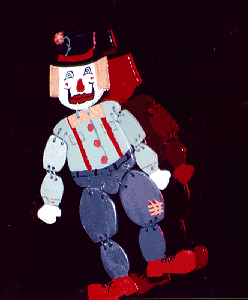
Susan Alexander‘s Cartwheels Gizmo Box is a collection of characters mounted on rotating shafts. As they turn, they appear like circus acrobatic clowns performing for an audience.

Detail of Cartwheels Gizmo Box by Susan Alexander

Susan has also designed another performance piece called Nervous People which are characters on radio-controlled platforms that move around stage briefly and then “spaz out.”

The Cartwheels Gizmo Box and Nervous People were exhibited at RoboFest 7.

These pieces are part of a series of theatrical robots and performance art being designed for stage performance. Brooks Coleman is directing the robot theatre movement.

RoboFest 7 Press Release

URGENT – FOR IMMEDIATE RELEASE

July 4th, 1996

FOR FURTHER INFORMATION CONTACT :
The Robot Group
P.O. Box 164334
Austin, Texas 78716
512-288-9135
http://www.robotgroup.org
robo@robotgroup.org

We interrupt this regularly scheduled program to bring you an important announcement. Local city officials were notified today of an impending invasion. The group claiming responsibility for the warning is none other than The Robot Group. The group made up of artists and engineers has quietly gone about creating robotic art forms for over seven years without incident. The Robot Group a local hi-tech arts organization well known for its annual technology festival RoboFest and as yet has no confirmed connections to terrorist groups. There are few details about the invasion other than a specific time frame.

The invasion is scheduled to begin on September 14th and will target the University of Texas area. There are unsubstantiated rumors that the invading force will use robots to conquer the Dobie Mall tower. The Robot Group would not comment on this rumor fearing retribution from the “outside force”.

The Robot Group claims that they are not responsible for the immanent [sic] invasion of Austin and are simply acting as the conduit for this warning. The group claims they were contacted and infiltrated by “outside forces” earlier this month. “These outside forces are way outside of our normal sphere of influence” claim the group “but they are forces that we have no control over”. The group would not elaborate on how this “outside force” made its initial contact or how they have taken control of The Robot Group. They could only add that the warning about the upcoming invasion was all that they could safely communicate.

The threat to Austin citizens and property is minimal as long as we cooperate they say. “Our cooperation is really quite simple. The only thing the invaders require is attendance to this year’s RoboFest” the group went on to say. For some unspecified reason this controlling outside force is demanding that thousands of Austin citizens be in attendance for a special message on September 14th and 15th. What will occur if the demands of the invading force are not met remains to be seen. The Robot Group claims that the “outsiders” have the ability to watch us constantly and that they know our every move. As proof of their ability to watch us closely from the sky, the invaders have commandeered one of the group’s blimps and will use it to monitor the invasion from the airspace around the Dobie Mall Tower.

Robot Invasion of Austin

It’s coming : the time to bias your transistors and heat up your resistors and march to RoboFest 7. The Robot Group will be hosting their seventh annual technology festival on September 14th and 15th in the Dobie Mall. This year’s festival will be the entertainment event of the year for robots and robot lovers of all ages.

The Robot Group wants the City of Austin to be recognized as the “Robot Capital of the World” and this is the first step in gaining that well deserved recognition. Every year the group assembles and re-assembles the dozens of robotic creations, that have graced the pages of Newsweek, Mondo 2000 and Fringeware Review, specifically for RoboFest. This year the robots are going back to school. RoboFest 7 will be held in Dobie Mall a stone’s throw away from the University of Texas and will feature many guest speakers and exhibits from our prestigious University. In addition the group’s most recent creations will continue to amaze the Austin audience. Plans for this year’s RoboFest include an outdoor flying blimp, a hexapod walker, an army of cardboard robots, and RoboVision a new telepresence application using video feeds from the outdoor blimp.

This year’s festival also includes a tie-in film festival with a robotic theme. The Robot Group will be presenting three classic films in conjunction with RoboFest. The film festival will be showing at Dobie Theatre which is also located in Dobie Mall. The films are two 50’s era sci-fi classics “The Day the Earth Stood Still” and “Forbidden Planet” and the ‘82 mega cult classic “Blade Runner”. The “Blade Runner” print will be the 35 mm Director’s Cut of the film and it will close both the movie festival and RoboFest 7. Admission for the two day festival is $4.00 for adults and $2.00 for children. The films will each have an admission price of $3.50. One hour free parking is available in the Dobie Mall parking garage located on Whitis Street across from Dobie Mall.
Resistance is futile Austin will be invaded come September.
Join us or you’ll regret it.

Editor’s note : The text of the original press release has been preserved without editing for spelling or grammar. Some links have been deleted whereas the others have been updated.

Commander Salamander – May 1996 update

Editor’s note : This information is for historical purposes only. I have done what I can to update links found on this page (current as of April 2020) but 25 year-old e-mail addresses …. Really?

The following is a first draft of limited distribution, offered for comment. In further versions numerical indexing will be added and the document will be split into linked web pages. Thanks for your input.

+==oOo===+

High Performance Micro-Blimp (HPMB) Design Notes and Draft Narrative Specification

+==oOo===+

Original April, '96 post to LTA builders list -

Members of The Robot Group of Austin, Texas are building a video telepresence micro blimp capable of outdoor operation in a moderate breeze.

The aircraft will start with short "over the horizon" video/control communications range, later adding GPS and other micro avionics to the payload.

We have strong record in indoor radio control/robotic blimps and are seeking advisors and collaborators for the outdoor work.

The current spec. calls for an 18 foot blimp, with about four pounds of elective payload, capable of cruise at 12 knots or more.

One goal is to incorporate a balloonet/water ballast system to enable "high" altitude work. Another goal is to incorporate solar cells to extend missions. These are open projects to jump on.

Anyone who wants to mirror this project with their own construction and share technical resources is welcome. Contact david@robotgroup.org .

+==oOo===+

Honing the configuration -

Many folks' design/build experience, research, and flying experience went into the working concept for the HPMB. Several promising configurations and related design ideas were competitively assessed (by scoring matrix) for potential speed, maneuverability, reliability, and simplicity of construction.

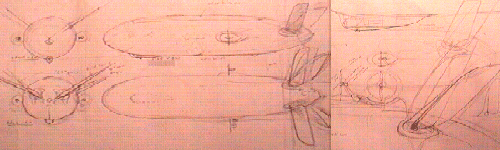
A baseline for review was the classic airship design which is pendulum stable with nonvectored bilateral thrusters. Two other candidate designs incorporated vectored thrust; one was a typical twin vectored thrust design with rudder and elevator. Another was a futuristic neutrally balanced concept with tri-radially mounted vectored thrusters and no control surfaces.

The top dog, so far, is a Vee-Tailed Twin In-line Thruster design which scores high in every functional category. Its fast, agile, robust, and simple.

The dashing vee tail is an update on classical blimp tail design that reduces part count by a third, plus a surprise; a quality microblimp's vee-tail can be quickly adapted from off the shelf RC glider wings. Well known vee-tails include the Stealth Fighter and classic vee-tail Bonanza civil aircraft.

The In-line twin propulsion units, mounted just aft of center, provide as much balanced power as the blimp can carry. The advantages of this mounting approach, as popularized in the Lear Jet and DC-9, apply to blimps. In this case visualize a fat wingless vee tailed Lear Jet. This picture also resembles NASA's early lifting bodies leading to the space shuttle design. Twin electric propulsion offers vigorous yaw inputs allowing the vee-tail to be flattened in favor of pitch control. The degree of flattening is balanced against the urgent need for rudder steering in the case of a single propulsion unit failure.

+==oOo===+

Control Particulars -

Following common airship practice, this blimp will fly slightly heavy (~200-1000 grams) balanced and trimmed like a conventional (in this case semi-acrobatic) aircraft. This allows the aircraft to slowly glide down in the event of a propulsion loss, still controllable by the vee-tail. In the event of total control failure a heavy blimp comes down in due time, without sailing off to the next state.

Although the prop units are balance mounted in-line close to the 
envelope's (horizontal) center of drag (and mass), the tail's drag causes the design to pitch up a bit when power is applied and the tail surfaces are centered. Trimming the tail down levels flight and some lift is scavenged, as in conventional aircraft. To balance pitch up maneuvering advantage, the pitch down position of the vee tail lightly interacts with prop wash, due to placement of prop unit and vee-tail.

To promote easy flying and allow emergency glide down, the design has a small amount of pendulum stability, balanced against a capability to loop and roll. In slightly heavy flight the vee-tail provides further roll stability due to its dihedral. Pendulum stability, general balance, propulsion and control surface placement will all be field tuned in test phases.

Loss of any one, two, or even three of the control surfaces or propulsion units results in proportional rather than total loss of control. A single tail foil allows feeble steering in glide mode and a single motor allows a curly cue course by timed throttle application.

The flattened vee-tail imposes a coordinated roll/pitch turn technique much like the rudderless elevon design of the Flying Sphere prototype. Differential control of the propulsion units allows aggressive yaw turns. Modern RC gear allows for mixing and tuning standard pilot inputs to make unusual configurations intuitive to fly. A note on RC glider wing reuse for vee-tails- ...existing tab ailerons suffice for control at high speeds, but for close slow maneuvering rotating the entire wing is more effective. Ailerons can be frozen in place, used as trim tabs, or mechanically slaved to overall wing rotation to reduce stall.

+==oOo===+

Communications Architecture -

The big issue here is whether or how to multiplex various high and low bandwidth data streams.

Some assumptions can be made -

-Use of RC control frequencies and protocols
-High Bandwidth Video/audio and sensor telemetry.
-Emergency Locator Beacon - a high intensity pulse useful for orienting narrow angle antennas and locating the blimp in case of a total mission failure.
-Antenna Garden - A combination of highly directional and omnidirectional switchable antennas is proposed.

===included comment from Mark C. Otto===

I have recently designed a telemetry system for use on my R/C airplanes that uses a 68HC11 and SuperCircuits ATV transmitter. The audio channel is driven by a modem chip off the HC11's serial port so I get full motion video and 1200 baud data on the audio. A modem on the audio output of the TV receiver feeds my HP palmtop with the data at RS232 levels and the palmtop stores it on flash disk. My only regret is that I didn't go with PC
 electronics for my transmitter - the lack of a sync pulse stretcher on the SuperCircuits transmitter prevents sufficient sync signal integrity to drive a VCR from the recovered video.

+==oOo===+

Avionics Suite -

GPS - Provides superior positioning info for "over the horizon" work. Can be integrated to GIS, etc.
Flux Gate Compass - Backs up GPS and provides pointing info if blimp is crabbing or yawing in place.
Two axis inclinometer - Provides attitude info in aerobatics.
Thermistor - temperature reading.

+==oOo===+

MicroVideo Components -

Current cam of choice is the PC-17 Color Microvideo Camera available thru Supercircuits. Its a 2.5 ounce, 450 line, 2"cube.

Supercircuits also offers a transmitter suitable for initial flights, the 915 MHz ATV-900 (is this the model that Otto says suffers from the lack of a sync pulse stretcher?).


+==oOo===+

Altitude Control -

As a rough goal, the design's lifting volume with proper altitude control gear should allow operation in excess of 3000 meters (stretched envelope if needed). 

Balloonet system - Keeps blimp envelope taut at lower altitudes and enables climbing without venting helium. Sub issues: a) maintaining a constant relative pressure in the envelope. A photo or micro switch tensiometer mounted on the envelope could sense flaccidity and trigger air pump. and b) selecting a lightweight air pump to pressurize the balloonet. In one approach a ram air inlet may assist a fan pump. In another scheme a small piston pump or motorized "campers air mattress" pump provides the pressure. c) Size of balloonet up to about a third of total gas volume.

Drop Ballast System - Allows blimp to lighten for maneuvering or to balance helium loss, rain/ice/payload pickup. Plain water entails freeze risk. Other options include powder or mealy media or antifreeze liquids.

Frost proofing - Low temperatures could affect electronics and embrittle materials.

+==oOo===+

Propulsion -

Two Graupner 400 motors with Olympus 2.3/1 reduction gears and between 8
and 12 inch props, size subject to tuning are being used. Such components are being specified with the help of electric airplane racing guru, George Parks and Wolf of American Angler and RC Hobby of Austin. A reduction gear and large prop operate more efficiently at low speeds and high altitudes than a small prop with no reduction gear.

Positioning - The small new human carrying Hornet blimp shares inline positioning of propulsion units.

Solar Power - 2-3 sq. meters of solar film or cells could generate nearly 100 watts of power for endurance missions. Amorphous solar films in on-hand catalogs are rather heavy for their power density. Crystalline cells are fragile, expensive, and laborious to install. Better solutions are sought.

===include message excerpt from David Beck===

Perhaps there is a way that the shape of the blimp could be adapted to
focus the sun on an array in the center of the blimp. That is, perhaps the
part facing up would be clear, and the lower part would be reflective. In the center of your tube, you could suspend an array at the focus point. This would keep the array weight down, yet still generate lots of power. 
Also it would protect the array, and with the money saved on buying lots of 
cells, you could buy a few more efficient cells. You'd generate a lot of heat at that point, so you don't want to collect too much sun, but on the
other hand, the heat generated could be used to generate additional lift - so maybe you'd want a series of tubes, and make a structure kind of like an 
inflatable mat.

===end included message===

Comment - The idea of a suspended solar array under a transparent envelope window may allow for optimal tilting to solar incidence independent of the airship's roll axis. The reflective trough idea is appealing as a means of minimizing cell count. Suspending a reflective sheet in the bag would result in a near optimal catenary shape. Unfortunately the lower refractive index of lifting gas means it can't be used as a focusing lens in a convex profile.

Batteries - The latest mainstream battery technology affordable by the project will be utilized, although Ni-cads are operationally acceptable for some missions.

+==oOo===+

Envelope and Hardpoints -

A big issue is using the Mylar gas bag as the primary envelope vs. as a liner for a fabric outer skin. At this point a naked Mylar bag with tape reinforcement will be used and later upgraded as it proves inadequate. This approach will save weight, cost, and complexity in trade off with durability.

Hardpoints are rigid foam structures supporting motors, tail foils, electronics, and batteries. Stress relieving tapered stringers radiate from the hard points and attach to "crow foot" reinforced anchor points on the envelope.

+==oOo===+

Vee-Tail Construction Note -

While slight deflections of small control surface areas suffice for cruising speed maneuvers, large areas and aggressive deflections are needed for good slow speed agility. A large area/deflection approach requires special care in designing large, strong, and light articulated mountings. An oversized elevon mounted on a tapered strake is the elected layout to make these trade-offs.


+==oOo===+

Rain Proofing -

Operation in wet weather adds weight and threatens electronics.

Electronics bays are to be modestly weather proofed similarly to autos using gravity gutters and gaskets while maintaining ease of access. Loops and rolls in rain are proscribed. Drop ballast should offset modest rain/snow/ice loads. Outer envelope material should be hydrophobic (like Scotch Guard), if not waterproof, without adding much weight from fabric treatment.

Electronics and other sensitive components are to be housed in insulated enclosures. Electronic waste heat may suffice to inhibit condensation. Silica packs could help. Ram air venting might be useful if the electronic bays are too well insulated for hot weather operation.

+==oOo===+

Test Flights / Mission Profiles -

Benchmarking - Speed, climb, lift, endurance, etc. would be established in early flights.
Cross Country - Following prevailing winds and conserving propulsion for course adjustment and landing.
High Altitude - Stripping all excess payload, the high altitude capability of the design will be tested.
Sample Pickup - Touch down on (calm) water to acquire samples for biological and chemical analysis.
Exploration in close environments - Urban and rural canyons, building interiors and other crowded locations put a premium on agility.
Station Keeping - Maintaining a constant position for as long as resources allow. Useful in comm relay work and observation. GPS automation a goal.
Robotic Operation - Testing of computer based autonomous control schemes.
Public Events - Ideas range from carrying a tiny video projector that displays thru the envelope, a la Bladerunner, to a "fire blimp" that tows pyrotechnics displays.
Ultimate missions - a) Search and rescue b) Hostile environments such as volcanoes and storms c) New RC Solar Challenger Blimp race (in parallel with Solar Challenger car race in Australia) d) New records for flight in the RP/A-LTA class d) Teletourism in farflung lands

+==oOo===+

E-mail list for this project (don't spam this list unless post is of
high interest to *both* LTA and Robotics folks) -

(Mark C. Otto) mco@hprtws13.ptp.hp.com,
(Martin J. Maxwell) maxwell@goodnet.com,
robot-group@cs.utexas.edu,
(John Piri) jpiri@ridgecrest.ca.us,
(Prof. John Canny) jfc@CS.Berkeley.edu,
(Reuben J. Hoggett) RHoggett@vitgcprm.telecom.com.au,
(Capt. David Guinn) QUINTI@aol.com,
(David Santos) david@robotgroup.org,
(Dave Beck) dbeck@execpc.com

+==oOo===+

Variants -

The basic design can be varied to achieve top performance in specialized missions.

Speed and endurance missions would benefit from a stretched envelope offering extra lift for bigger motors and/or more batteries.

Absolute speed records will require gas engines.

Indoor acrobatic models should have shorter fatter gas bags and bigger control surfaces for turning ease.

A stripped down low cost version would be popular even without all the fancy high-altitude all-weather solar-boosted fully-instrumented features.

+==oOo===+

Autonomous Flight -

Several approaches are of interest. One is to integrate GPS/GIS based cross country navigation by an agent such as AirSoar. Another tack is to do local exploration based on interpretation of proximity sensor data. A third approach is complex mission level behavior as in Orca, the top level intelligence in the MSEL EAVE architecture. (See URLs section for links to above)

Ultimate integration of the various schemes would allow varied missions with intelligent response to dynamic local changes within an absolute navigation framework.

+==oOo===+

Rapid Response -

For some applications, such as search and rescue, a rapid response blimp system is required. This aspect may long remain at the concept phase, but has interesting challenges. Obviously an inflated blimp taking up a lot of space and constantly losing helium is not good in a low usage rapid response mission unless instant operation is needed. A better solution is a suitcase sized package that stays charged and self-inflates and takes off automatically. Waiting for a volcanic eruption is a cool application idea.

+==oOo===+

Legal and Safety Issues -

A comprehensive set of safety features and operational policies shall govern the use of the airship.

Prop hazard - Props will be orange tipped and have a piano wire hoop to guard against contact with people and objects. Prop operation will only occur away from close proximity of third parties.

Plummeting hazard - All components of the blimp will be tied together. All high density components will be mounted on low density structures as shielding. Total loss of lift should result in a drop speed of no more than 30 mph.

Fire Hazard - No combustible fuels or ignition sources will be carried in normal use.

Navigation hazard - About half our team members are pilots and understand the regulations and issues involved. (most senior pilot/consultant is a 747 captain for United, others are already flying HTA RPV's under govt. contract)

Great care will be taken to follow applicable aviation law and best safety practice with this project.

+==oOo===+

Related URLs -

A preliminary page exists for this project, but contains nothing not
found in this document. Stay tuned for a hot concept rendering and
configuration sketches, plus updated specification info -
http://www.polycosmos.org/ROBOTGRP/ROBOBLMP/CMDRSALM.HTM
(archived at the Internet Archive)

Dr. John Canny's net blimps (Space Browsers) telefloat beyond the
surly bonds of earth -
http://vive.cs.berkeley.edu/blimp/
(archived at the Internet Archive)

Supercircuits is the project's micro video supplier. If you haven't
seen their catalog you'll flip out when you do -
http://www.scx.com/supercircuits.html

West Coast Blimps is worth checking out for envelope materials and
other products -
http://www1.ridgecrest.ca.us/~jpiri/
(archived at the Internet Archive)

The UK Hornet Blimp is an advanced design that shares some
performance features with Capt. Salamander -
http://www.fast-lanes.com/Hybrid/Advanced_Hybrid_Air.html
(dead link, not archived at the Internet Archive)

Air-Soar is a good example of an autonomous flight agent -
http://krusty.eecs.umich.edu/air-soar/
(archived at the Internet Archive)

Underwater robots share many control and mission characteristics with
airships -
http://pha.cs.unh.edu/MSEL/architecture.html
(dead link, not archived at the Internet Archive)

+==oOo===+

Work to date -

-Project documentation undertaken in draft.
-Blimp envelope builder's instructions written for web.
-Provision of Mylar and assistance to Dr. Canny, Berkeley CS, and Brooks Coleman.
-Propulsion consultation with electric airplane guru, George Parks.
-Eight microblimp related pages created.
-Construction begun on Propulsion Nacelles.
-Research progress on various fronts; physical configuration, video/control communications, balloonet/water ballast altitude control, propulsion, avionics, etc..
-Mark IV envelope reallocated to helilifter blimp. HPMB to have new
envelope.

The Captain Salamander name derives from a local (Austin,Texas) biologist's (Jim Collett) concept for a Barton Creek water quality inspection blimp.

Generic Intellectual Property Statement - Free noncommercial personal and educational use encouraged. dave@faustex.com

Want to build a micro-blimp? Instructions on fabricating envelopes are available.

Comment to webmaster@faustex.com
Hot-Tool Fashion Show

Editor’s note : The information on this page was gleaned from Dave Santos’ PolyCosmos site (polycosmos.org) via the Wayback Machine. The information from several pages has been concatenated into a single page.

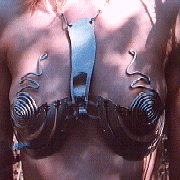
Hot-Tool Premiered on October 27, 1995 in Bastrop, Texas. Austin’s intelligentsia was present. Brooks Coleman is the creator of Hot-Tool.

Subj : EVENT - Brooks Coleman, Hot-Tool Fashion Show 2.0
Date : 96-05-04 03:13:49 EDT
From : email@fringeware.com (FringeWare Daily)
Reply-to : email@fringeware.com (FringeWare)
Sent from: email@fringeware.com (FringeWare)

*** TEXAS NEWS FLASH  *** TEXAS NEWS FLASH  *** TEXAS NEWS FLASH ***

THE SECOND GATHERING in a series of ongoing HOT-TOOL FASHION CREW fashion shows will go online tomorrow, Sat 4 May 96, in Bastrop TX at Brooks Coleman's treehouse -- one show at 10p and another starting sometime after 2a, after the second shift of models arrive.

If you know Brooks and you know how to get to his house, and you agree to mind your P's and Q's while a flurry of gorgeous young women bare  all on stage, probably for their first time, in front of howling crowds of Coors-drinkin' rednecks, metropolitan art weenies, industrial geeks, and world-renowned robotics experts, while wearing precious little more than a few scraps of metal and plastic, then you're invited.

Brooks Coleman is a charter member of Austin's The Robot Group, and one of the organisers of the annual RoboFest event held here.

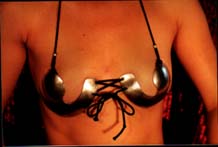
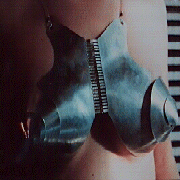
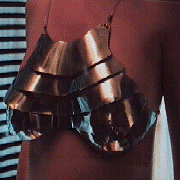
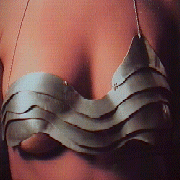
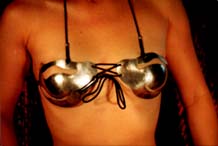
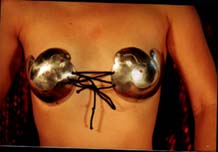
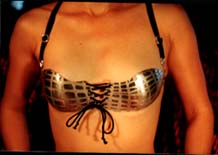
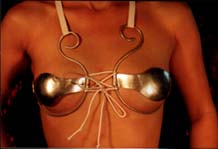
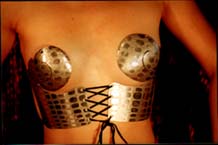
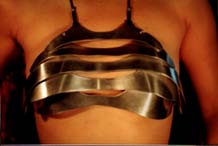
HOT-TOOL FASHION CREW features custom designed and fitted "art bras" and "art skirts" made from recycled industrial materials ... if you've ever seen Brooks' robotic sculptures or p'haps ever seen a video of a Survival Research Labs show, you get the point ....

Currently, art bras / skirts sell within the range of $50-$100 each. The first three patrons to drop by the FringeWare store at 51st & Duval in Austin, may request an art bra/skirt coupon for $10-off, with purchase.

The previous show, on Halloween 95, proved to be one of the premier art gatherings in this part of the North American continent -- for reviews and details, please browse some of the URLs listed below, in addition to Brooks' press coverage in Mondo 2000, bOING-bOING, Discovery Channel, etc.

Attendees at this night-long fete are requested to bring flashlights and coloured lightbulbs if possible to help illuminate the newly built  woodland trails. Hiking will be included along with the usual Wall of Gizmos and techno-industrial-redneck runway glam fanfare.

Located between Austin and Houston, the party will be out in the glamorous pine hill country of Bastrop County. Bring plenty of water, in case y'all get lost on the way out there.
 
Hot-Tool Fashion Crew Home Page ->
     http://www.polycosmos.org/BUSINESS/HOTTOOL/HOTTOOL.HTM
HOT-TOOL review in Don Webb's "Letters to the Fringe" ->
     http://www.fringeware.com/tazmedia/dwebb/letter16.html
     http://www.fringeware.com/tazmedia/dwebb/letter17.html
The FWR article about Brooks, by Allen Varney & PXN ->
     http://www.fringeware.com/FWR/fwr03-31.html
 
Brooks Coleman
Hot-Tool Fashion Crew
Lot 9, Section 3
PO Box 1403
Bastrop TX 78602
+1 512 303 3310
elmice@eden.com

Commander Salamander

The Robot Group is extending its experience with indoor blimps to the great outdoors.

Using a surplus envelope for the Mark IV and adding hot model airplane competition motors spec’d by guru George Parks, plus a video link and possible GPS unit we could demonstrate many new mission capabilities. Tom Davidson is designing and implementing the spread spectrum over the horizon video/data link.

Wish list :

1) mini GPS w/ serial port. I ‘m callin’ Trimble right now.

2) Balloonet system enabling stratospheric missions.

Missions will include sports events, natural disaster scouting, and environmental monitoring.

The Captain Salamander name was derived from local biologist’s (Jim Collett) concept for a Barton Creek inspection blimp.

Progress report by David Santos May 1996.

Generic Intellectual Property Statement- Patents mostly pending. Designs protected by copyright. Free noncommercial personal and educational use encouraged.

More on the Megabot Army

The Megabot robot series is a design for a muti-purpose utility robot. Project members, Norm Annal and Glenn Currie, developed a design similar to that of a toy robot, but on a much larger scale. The design specifications call for the robots to be made of plastic and dense foam. There will be different models and they will range in height from 8 to 24 feet tall. Sensors will provide an array of interesting sounds and dazzling light effects.

Megabot Proto 1

The Megabot Proto 1 was the first prototype of the Megabot series. It was constructed from recycled materials and off-the-shelf items. This robot demonstrates that robots can be built from very inexpensive materials like cardboard.

Let’s begin at the base. The oversized eet and legs are carved from corner strips of foam packing material using a razor blade. The leg pivot-points rotate on PVC tubing, and turn inside bushings made of plastic tubing cut into short lengths, which are then sunk into the foam lower limbs and lower torso. Cardboard from pizza boxes and shipping cartons were used to reinforce these leg and foot parts. The cardboard is attached to the foam pieces with glue and sturdy toothpicks.

The feet are modular and easily replaced . They are also constructed of foam but with are reinforced with a fiberglass coating. A cardboard-covered foam wheel is embedded in the rear of each foot. Each wheel rotates on PVC tubing which also connects the foot to the lower leg bone and the forward-lifting shin bone. A microswitch, inserted into the bottom of each foot, will be linked to a sound chip to produce mechanical sound and/or the activation of warning lights during foot movement.

The lower torso houses the motor and battery power for the robot’s movement. A battery operated socket wrench serves as the motor unit. A small bicycle gear, welded to a 1.12 diameter socket, turns a larger gear which then moves the offset rotating cam. The cam is constructed from PVC tubing. A small length of bicycle chain is also used. The gear box is currently constructed from layered and shaped cardboard which proved to be too weak and flexible to maintain the rigidity required to keep the gears apart. Stiffer cardboard or plastic-coated cardboard could solve this problem as well as the flexing of the PVC and compression of the foam.

The upper torso is made completely of cardboard and is easily removed and replaced with other upper torso designs. This robot is designed with a lot of modular components so that it can be easily changed.

The head piece is a plastic helmet filled with foam, a battery pack and small lights. It is mounted on a PVC tube for side-to-side rotation. The foam neck section pivoted forward and backward. All this weight proved to be too much for the motor and gear box in the Megabot Proto 1.

Plans were made to lighten the load for the second prototype.

Megabot Proto 2

For Megabot Proto 2 (MP2), the robot design went almost entirely to a cardboard-based unit. The legs and feet were constructed only of cardboard eliminating the heavier foam pieces. The cardboard material was cut and glued at right-angles to add strength to the design. The motor and gear box unit were removed from the MP1 for use in this second version. No major modifications were made in the original design for these pieces.

The upper torso again is completely cardboard. The hand and finger digits are carved foam with sturdy toothpicks for the pivot points. The digits can be manually positioned now but plans are to have them servo-controlled.

The head piece on the MP2 also went to the lighter cardboard version eliminating the plastic and foam from the first prototype. The MP2 head and arms are intended to be covered and eventually used for molds for mass production of the Megabot Army. Small servos could be adapted to move and control the head and arm pieces.

This version of the Megabot, the MP2, successfully walked for a brief period in a test work-session. The test walk proved that the design concept is good. Additional work is needed to replace parts where stronger materials are to be used, for example, in the gear box unit. In general, all the high-stress points on the robot should have stronger or plastic-coated cardboard.

The current robot shell on the MP2 is very impressive looking. The robot face appears to be an animal snout and the side profile shows pointed dog type ears on the head piece. The cardboard pieces were painted black and the eye socket areas are set back and painted red. The complete head piece gives the appearance of a space helmet for a robot dog.

The leg and lower torso units are also painted black while the upper torso unit is blue. The PVC pieces are painted red and the foam pieces on the hand were painted yellow.

Norm put over 1,000 hours of time into this project individually cutting and molding each of the pieces for the two units. In addition, he did the design illustrations for the project. Glenn also assisted in the design and work.

Megabot Army

The Megabot Army was an attempt to build a 6 foot tall robot out of regular cardboard that you would assemble by folding (akin to the manner in which you would assemble a cardboard file-storage box).

“When we give demos at schools, the kids always ask about a robot kit. Robots get expensive very quickly.”

Glenn Currie


Norm Annal did much of the design which was fed into AutoCAD. The output file was used to drive a CNC prototype box-cutter at Capitol Container in Buda TX just south of Austin. Capitol Container cut about a dozen of the robot kits for us and several have been assembled and used in various displays.

The nice thing about having the drawings in AutoCAD is that we can adjust the size easily. One 3 foot tall version of the Megabot was built. I need help on this project. It has been in the attic since Robofest 7. Many thanks to Capitol Container – those folks can make anything out of cardboard.

Read more about the Megabots

Schwa Stay Awake Sumou Robot

Inspired by Bill Barker’s Schwa drawings this little bot was designed, by Tom Davidson and Sonia Santana, for RoboFest 5’s Robot Sumou Tournament.

The Robot Sumou Tournament was inspired by the wildly popular robotic competitions in Japan. The official Robot Sumou have very strict design rules. The object of the competition is very simple – push the opponent out of the playing field circle.

The rules of the sumou robot competition are as follows :

  1. The area of the base of the robot can not exceed 20cm by 20cm before the game starts. This means that the height is not limited and it may spread after the competition starts.
  2. The weight of the bot can not exceed 3 kg.
  3. Use of internal/external combustion (ignition) engine is prohibited.
  4. Intention to harm the opponent or the Dohyou (playground which includes the competition circle) is prohibited.
  5. The way to control the bot is free, but divided into two categories – Radio Controlled and Stand Alone.

The Stay Awake Sumou robot was designed from a Blackfoot Radio Controlled (RC) truck motor and RC transmitter. These were its most expensive parts and replacement cost for the RC vehicle is estimated at $200.00.

Hobby tires were purchased for the back end and Lego tires were used in the front. Lego bridge pieces were used to design a front-end steering drive using servos.

The 20 cm x 20 cm requirement made it pretty difficult to put very much in the bot’s base. Everything inside the shell is pretty tightly packed, including a six cell battery gel pack.

The exterior wedge design was chosen for offensive strategy reasons. It seemed, from our research, that a lot of the winning designs in the Japanese competitions were wedge-shaped. The wedge shape prevented the ‘bot from being turned over and, it was hoped, would help the ‘bot get under the competition.

The shell housing is a roof ceiling exhaust duct that was hacked down to the size requirements. The rough edges were smoothed out by filing and the old reliable standby, duct tape, was used to cover the base edges. Cost of the shell was about $5.00.

The decorative antennae and clear plastic dome on top were pieces bought at garage sales for about $3.00. The dome unit had an array of LCD lights that blinked to make it appear that the Schwa had some thinking process going on. It also provided the area for the RC antennae to come out.

The Schwa symbol stickers were purchased from the Schwa Survival Kit by Bill Barker that was distributed by the late, great FringeWare. The bumper sticker on the backside which covers most of the back area says “Whatever Happens Do Not React!”

Kids loved the ‘bot and many wanted their very own.

Since the motor driving the Blackfoot truck is pretty beefy, the Schwa Stay Awake ‘bot was very fast. Our hope was that, once it got in the ring for the competition, it would be able to flee any opponent and be fast enough to react quickly to any threat.

That was true for the most part. The difficulty came in the realization that our motor had insufficient power to push its opponent out of the ring. It would engage the opponent maneuvering quickly to take the side-attack approach.

The winning robot however, had quite a bit of mass and was almost immovable by Schwa. The winner, a Vadim Konradi design, had a very strong wheel chair motor.

It was a doomed competition from the start, a tortoise and the hare type match-up. Vadim’s sumou ‘bot was slower but steady in its determination. Schwa could run circles around him but did not have enough real power to push him out of the arena. It became a matter of time : batteries would drain or time limits would kick-in.

Realizing that it could not win, Schwa surrendered itself to its more powerful opponent and the Konradi ‘bot steadily pushed it out of the ring.

The Stay Awake ‘bot was not fazed however; it quickly resumed its duties entertaining the kids in the crowd who delighted in running after the funny looking RC ‘bot.