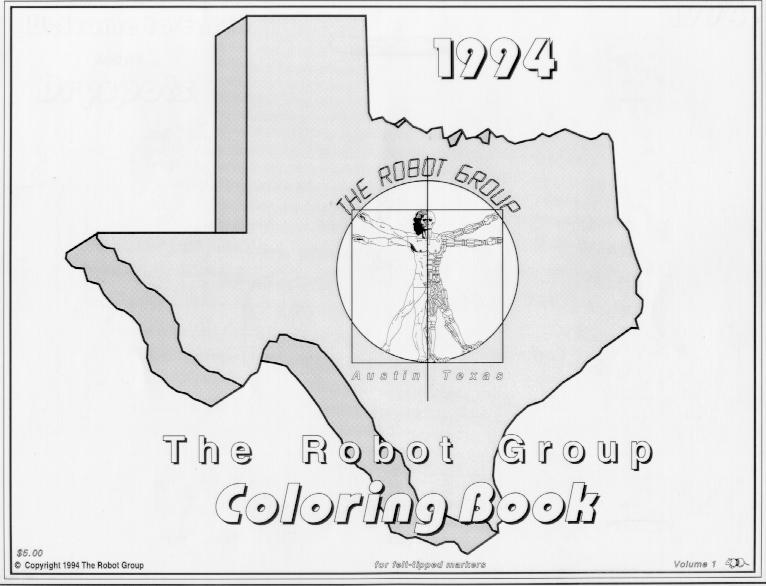
The Robot Group Coloring Book

The Robot Group Coloring Book [2 MB PDF download], by Norm Annal, was released in 1994.

It was a great effort to document designs of various group projects that were either already completed or still in the works. This book is pretty rare as there were only a few hundred copies printed.

The Robot Group Coloring Book - Blockheads
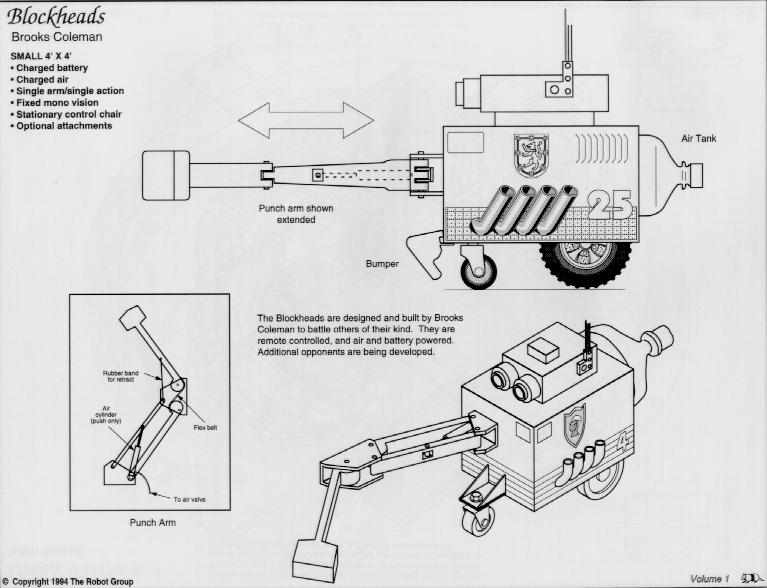
Brooks Coleman’s Blockheads, an illustration from The Robot Group Coloring Book

Norm is a talented CAD graphic artist with a background in mechanical design. Norm also designed The Robot Group logo.

The Robot Group, Inc. logo, color version (copyright to The Robot Group, Inc., design by Norm Annal).

His schematic drawings of our projects have always been of extremely good quality and accuracy. This book is far from being a simple coloring book. Norm put in a considerable amount of time in assuring that this project would be both artistic and educational.

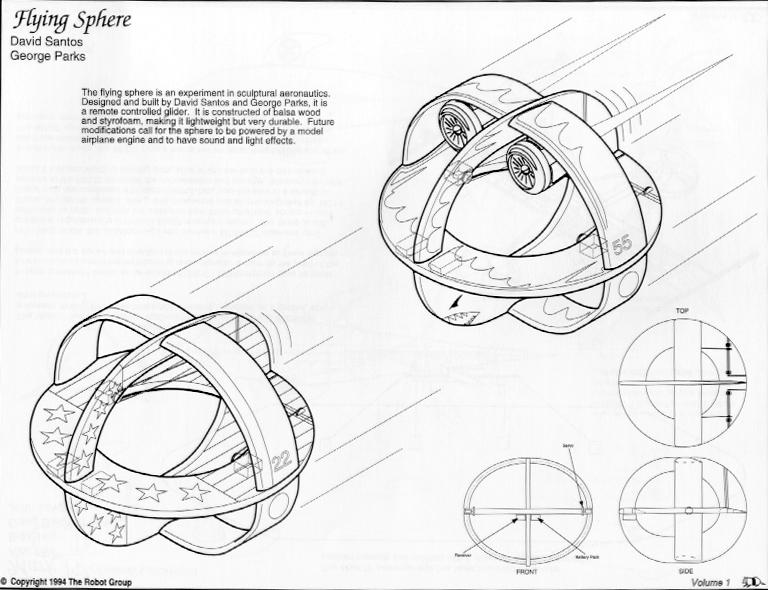
The Robot Group Coloring Book - Flying Sphere
Flying Sphere, by Dave Santos & George Parks, an illustration from The Robot Group Coloring Book

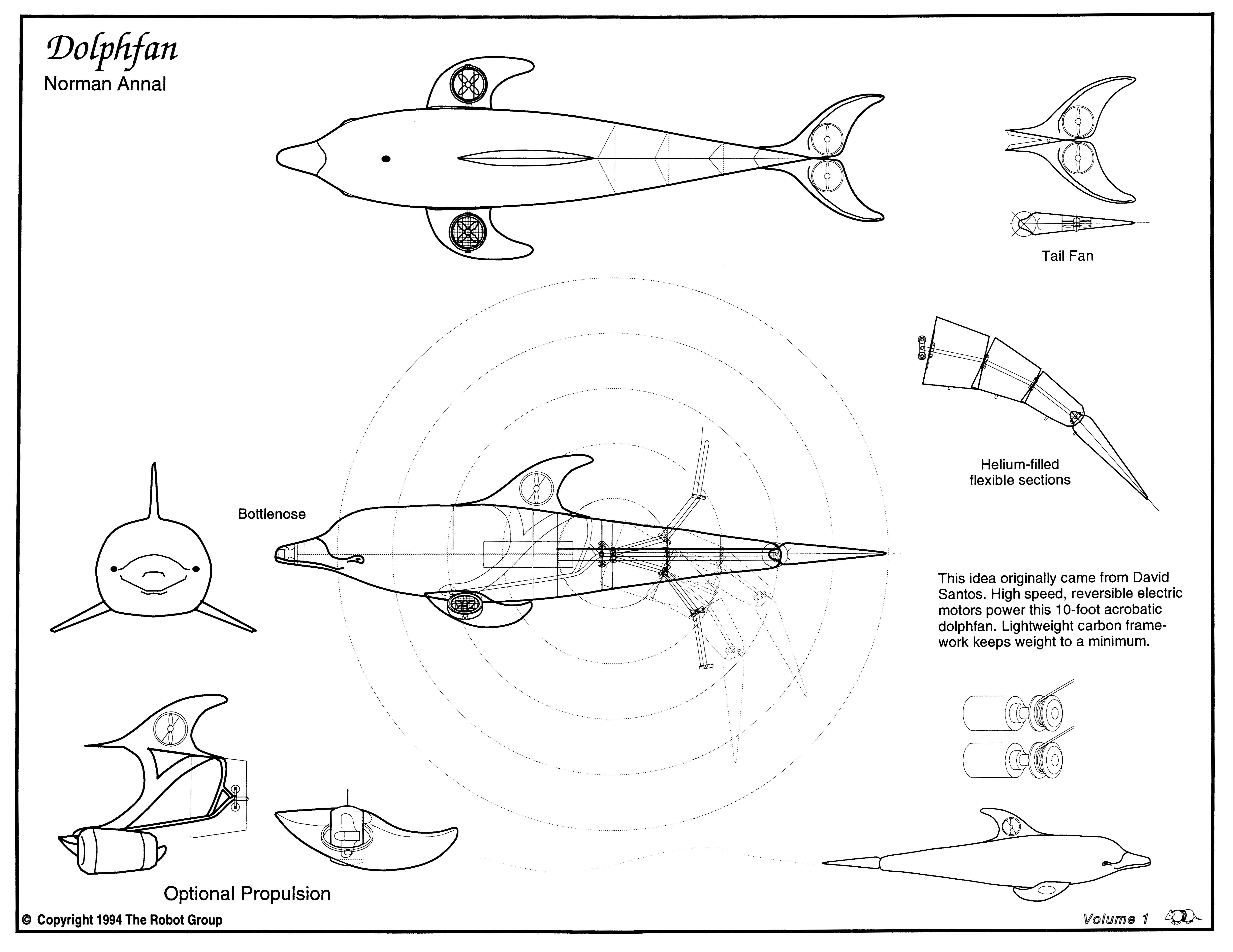
It documents 14 group projects with 16 original drawings of such favorites such as Varmint, Bipedal Ornithopter, Flying Sphere, Dolphfan, Mark IV Blimp, and Dweebvision.

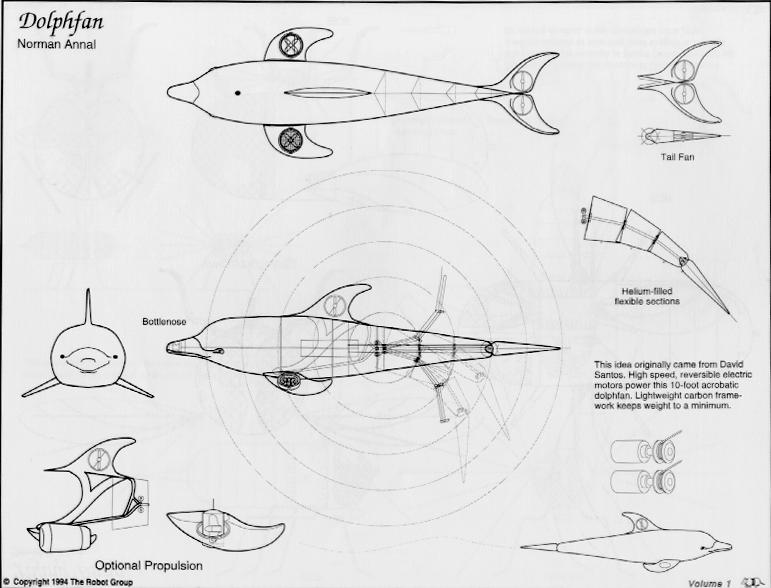
The Robot Group Coloring Book - Dolphan
Norm Annal’s Dolphan, an illustration from The Robot Group Coloring Book

The book was sold at RoboFest 5 and distributed to various schools during outreach visits.

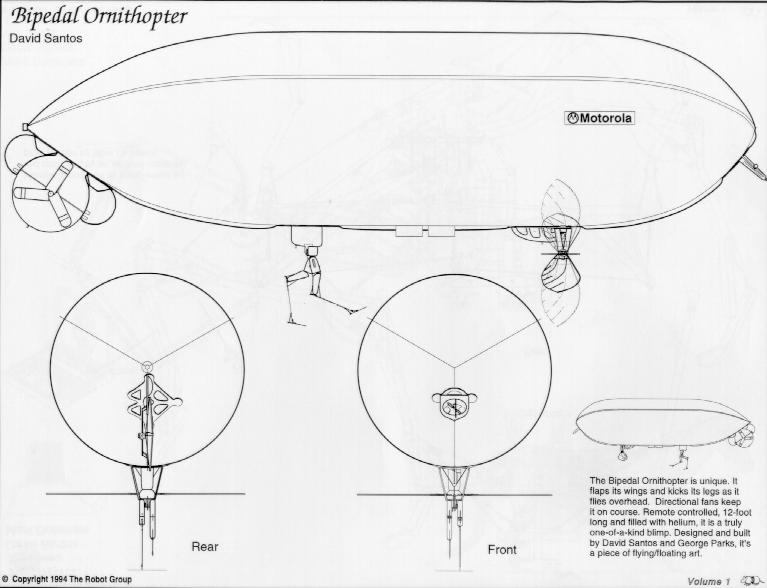
The Robot Group Coloring Book - Bipedal Ornithopter
Dave Santos’ Bipedal Ornithopter, an illustration from The Robot Group Coloring Book

RoboCacing

Wan Yik Lee‘s RoboCacing was an amazing, fully-autonomous robotic worm which moved like a leech until provoked.

It was approximately two-and-a-half feet long with a metallic, segmented body covered with bristles used to sense its environment. Two antenna at its head probed for front obstacles. On sensing danger through its bristles, it sped-off to escape. Different responses were produced for different sensations received through its bristles and antenna.

RoboCacing (from ‘robotic’ and ‘cacing,’ the Malay word for worm) was built specifically for RoboFest 5 (1994).

Mark IV Cybernetic Airship

The Mark IV Cybernetic Airship, aka Mark IV Neural Net Scanning SONAR Blimp was next in the evolution of the blimp projects.

Craig Sainsott designed and built the blimp under carriage. Alex Iles and Bill Craig were responsible for the electronic and computer implementation. John Lovgren developed the neural network learning program. Brooks Coleman was the training pilot. Read more of the technical details on blimps.

Flying Sphere

Model aviation guru, George Parks, built the Flying Sphere aircraft in collaboration with aviation artist, Dave Santos.

George selected a thick slow speed NASA airfoil for the RC prototype.

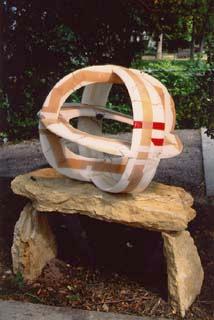
Flying Sphere by George Parks, inspired by Dave Santos.

The overall impression of the Flying Sphere design was that it flew about as well as conventional designs. It had interesting structural and aerodynamic qualities due to its relative absence of wingtip vortices, its spread mass, and its peculiar “rolling ball” landing style.

Flying Sphere detail
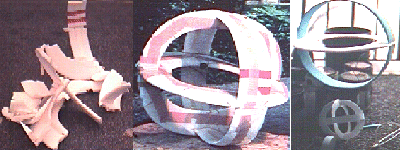
At left is the wreckage from an early crash. The center photo, by Karen Pittman, shows the repaired aircraft. At right are various small prototypes by Santos. One version, a sort of “pendulum kite” on a monofilament and bamboo pole was a mind-bender at Austin raves in the late eighties.

This project was one of several designed by David Santos to demonstrate far-fetched concepts. Others were a boat that sails directly into the wind, a rain-powered vehicle, the ProtoAndroid, and the Bipedal Ornithopter, a flapping-wing flying machine that runs on legs to take off.

Intellectual property statement – Patents pending. Designs protected by copyright. Noncommercial personal and educational use encouraged.

The background material for this page is derived from an archived page on the Internet Archive Wayback Machine. Some links may have been added, removed, or updated.

The Great Wall O’ Gizmos

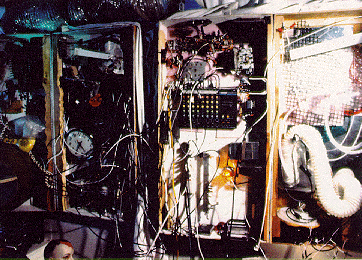
The Great Wall O’ Gizmos is a continually-growing exhibit of interactive junk art technology by Brooks Coleman. It made its debut at RoboFest 4 (1993).

The boxes in the wall are modular and can be stacked and connected in different ways. A multitude of clocks, sequencers, lab timers, and dishwashing machine timers turn dissected appliances and gizmos on and off like crazed monkeys.

This is another creative use of recycled material from our resident junk yard art genius.

Rover

Rover, another Wan Yik Lee creation, was a homebrewed robotic base powered by two motorized wheels which were controlled based on differential velocity. A SONAR system was mounted on top of the base.

The base had a dedicated microcontroller to allow it to accept various motion commands through a serial port. Encoders wee mounted on the motors to provide motion feedback.

The SONAR system consisted two parts :
a) a ring of sixteen uniformly-mounted Polaroid SONAR transducers, and 2) a microcontroller with two Polaroid SONAR drivers to accept various sensing commands and to control the operation of the sensing system.

The SONAR ring was adjustable to a height between 30 inches to 38 inches and could be programmed to sense according to various schemes.

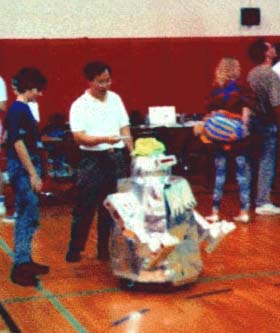
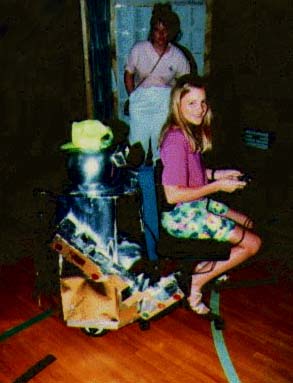
Rover had been dressed up as a space-age android, and exhibited as a human transporter in RoboFest 4 (1993) and RoboFest 5 (1994). It served hundreds of human drivers using a Nintendo joystick controller as the interface for motion command.

Wan Yik Lee's Rover takes another happy RoboFest 4 attendee for a ride. Notice the Nintendo controller?
Wan Yik Lee’s Rover takes another happy RoboFest 4 attendee for a ride

Dweebvision

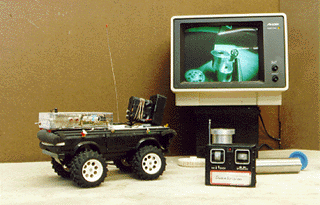
Dweebvision, a low cost video telepresence rover, is one of Glenn Currie‘s creations. A durable as it is simple, Dweebvision has survived operation by hundreds of kids over five RoboFests and many school events.

The Dweebvision vehicle is a radio controlled toy car, equipped with Pixelvision video camera and transmitter.

The chassis is made out of an “after Christmas” special 4-wheel drive truck from Radio Shack. The remote control for steering the base is on ~27 MHz. and offers no interference for the 900 MHz. audio-video transmitter. The unit runs for about 4 1/2 hours on one set of alkaline batteries. I added a xenon strobe to Dweeb for safety because all kids want to do with it is drive up behind someone and have them trip over the robot.

The person at the control station sees and hears the world in Dweebvision, and can control the car as it navigates its surroundings by viewing a monitor. Many of the children visiting RoboFest watched in amazement as no one seemed to be controlling the RC car. The navigator can sit out-of-sight from the vehicle and have a little fun teasing the kids.

“I built the group’s first telepresence bot called Dweebvision. It has (yes, it is still working) a Fisher Price Pixelvison camera attached to a 900MHz. audio / video transmitter. Dweeb sends back live video and sound. The automatic audio gain control in the Pixelvison camera works perfectly – reducing the audio while the unit is driving around and the noisy plastic gear motors are on and increases the microphone sensitivity when the motor noise stops.”

Glenn Currie

Dweebvision was built, overnight, before Robofest III, after collecting all the parts over the period of a few months. It gets updated, at times, with a night vision camera and has been used to scout out problems under an ice rink and look for pets under houses. Dweeb is a telepresence device and is run by a remote operator. It has no on-board microprocessor or brain. When I was in school we called a person with no apparent brain and a head filled only with that which was put there by others, a “Dweeb”.

“Dweeb has been used in countless demonstrations over the years. I found attaching the camera and video transmitter with rubber bands and Velcro was the way to go. Anything less flexible was trashed in no time. With rubber bands and Velcro I simply pick up the “big chunks” of the robot after it has been stepped on and mash them back into place. Most schools have walls of enameled brick and Dweeb gives a great demo when driven between desk legs in nearby classrooms. Dweeb is small and travels in a cardboard file box to school demos.”

Glenn Currie

Dweebvision was the first of the telepresence robots created by Robot Group members. The Mobile Platform followed soon afterwards.
Outreach : Berzerkworks, August 1991

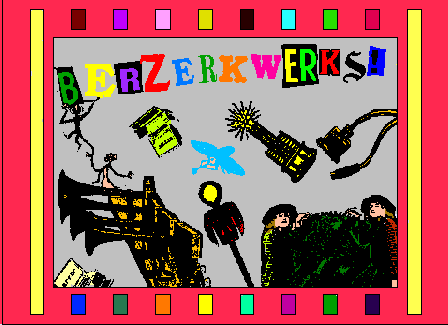
The Robot Group, in a collaborative effort, produced an installation entitled “Berzerkwerks” which was on display during August of 1991, at the Austin Children’s Museum.

The work consisted of various computerized kinetic sculptures interactively-controlled by a central computer through a video input device. The observer’s moving image was dynamically captured by a video digitizer, and mixed with computer graphics. Interaction of the captured image with the computer graphic objects controlled the behavior of the sculptures. The combined image was then projected onto a large screen.

In addition, several of The Robot Group members participate in an annual Berzerkwerks outing now called Jump Start.

The program is taken to local elementary schools in at-risk areas. These shows are very popular with the kids. By encouraging these youth to be interested in science at a young age, we hope to help them stay interested in school.

Who knows? The next Einstein could be right in our backyard.

Exhibit Controller Board

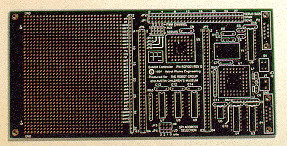
Another effort of The Robot Group has been to develop a multi-purpose microcontroller system appropriate for controlling motors, sensors, and other devices.

Connected together in a network, groups of these systems can be controlled via a higher level central computer. This can be used to control complex robotics systems and can produce striking behavior of museum exhibits, and information about exhibit behavior and crown activity and interaction from one exhibit to the next.

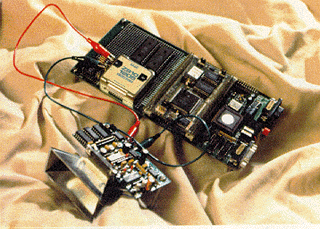
The Exhibit Controller Board was initially designed as part of the Berzerkwerks (Aug. ’91) exhibit at Austin’s Children’s Museum and subsequently has been used in several Robot Group projects.

It incorporates a methodology to allow the onboard Motorola MC68HC11E9 microcontroller to control up to 28 servo motors. Each system provides connection for a Motorola MC68332BCC, a small but powerful MC68332-based computer system, which may act locally or serve as the master controller for up to 14 other systems.

Exhibit Controller Board (unpopulated), created by Bill Craig and Alex Iles

Alex Iles designed the hardware and the software for servo control. He later revised the design to incorporate MIDI communications and to reduce the size of the circuit board.

Bill Craig developed a real-time distributed operating system allowing the network of exhibit controllers to operate at its full potential. The operating system runs on a Motorola MC68332BCC (which acts as the central controller) mounted on one of the networked boards.

Projects incorporating the exhibit controller include Big Rock Robotic Tower, Sparky, the Robotic Pup, and the Tai Chi Dancers (a moving sculpture consisting of choreographed robotic arms, which utilizes a network of controllers and the distributed operating system).